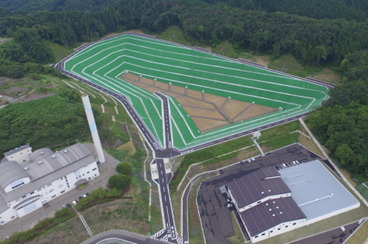
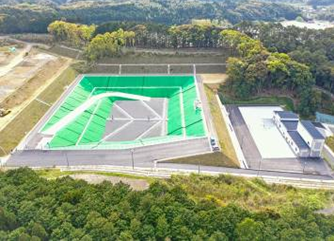
Semi-Aerobic Landfill (“Fukuoka Method” Landfill)
The Fukuoka Method Landfill, also known as the Semi-aerobic Landfill, is a pioneering waste disposal technology developed in Fukuoka City, Japan, in the 1970s. It was originally suggested by Dr. Masataka Hanashima, a current professor emeritus of Fukuoka University.
Its core principle is to promote the aerobic decomposition of waste within the landfill by naturally being supplied the air, leading to earlier stabilization of the waste.
*Reference (Fukuoka city): https://www.city.fukuoka.lg.jp/kankyo/k-seisaku/hp/FM.html
What Are the Key Feature and Structure of the Fukuoka Method?
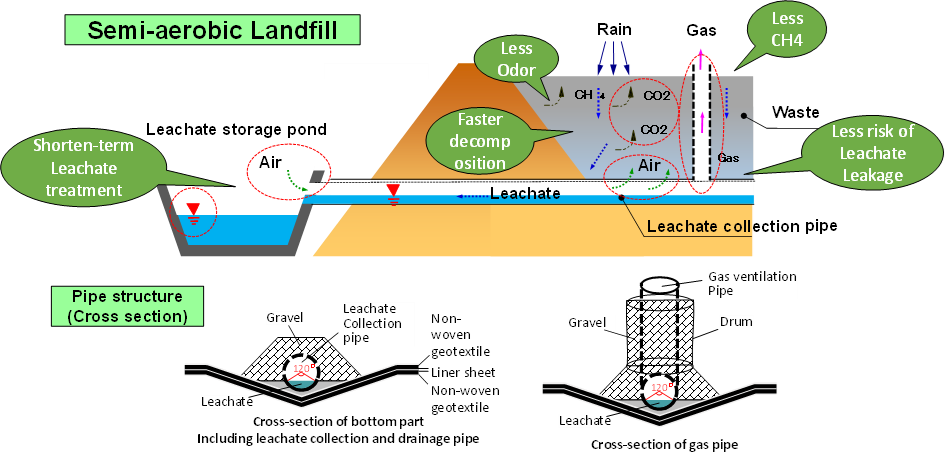
Unlike traditional anaerobic landfills, the Fukuoka Method employs a unique structural design to facilitate natural air circulation and leachate management:
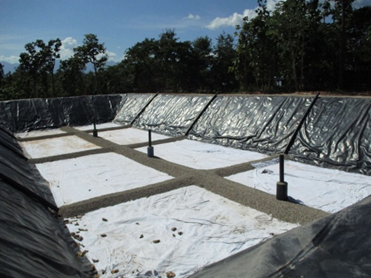
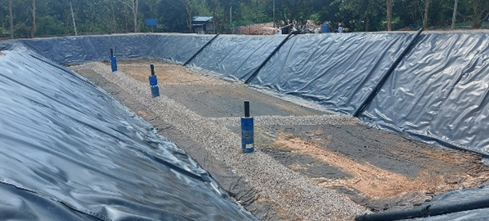
Leachate Collection and Drainage Layer: A crushed stone layer is installed at the bottom of the landfill, acting as an efficient leachate collection and drainage system.
Leachate Collection Pipes: Perforated pipes are embedded within the crushed stone layer to collect and remove leachate effectively.
Gas Venting Pipes: Pipes are placed at the top of the crushed stone layer, extending upwards through the waste body. These pipes facilitate the natural inflow of air (Oxygen) into the waste due to temperature differences (convection), creating semi-aerobic conditions. The oxygen helps to decompose waste materials by aerobic bacteria and decreases methane in the decomposition process.
Rainwater Infiltration: The method strategically utilizes controlled rainwater infiltration to increase leachate volume. This continuous flushing action helps prevent leachate stagnation and promotes its circulation, contributing to faster water quality stabilization.
What Are the Advantages and Benefits of Fukuoka Method?
This semi-aerobic approach offers significant environmental and operational advantages:
(1) The Fukuoka method utilizes the self-purifying capacity inherent in nature, that is decomposition by bacteria, to stabilize waste materials. The landfill method requires only commonly used machinery and equipment.
(2) Accelerated waste decomposition significantly improves leachate quality.
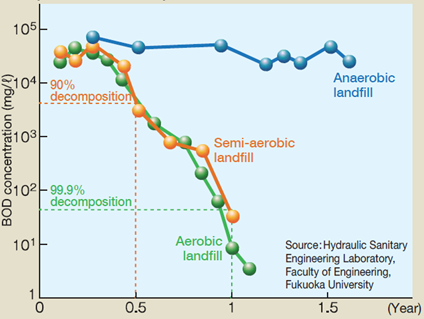
Comparison of the Trend of BOD concentration
*Source: Ministry of the Environment, Japan
(3) It reduces methane gas, helping prevent global warming by reducing greenhouse gas (GHG) emissions.
*Refer to the IPCC Methodological tool: “Emissions from Solid Waste Disposal Sites” (version 8.1), as one of coefficient value setting for calculation of GHG emission amount, the default value for Methane Correction Factor (“MCF”) is set as
- 1.0 for Managed anaerobic landfill
- 0.5 for Managed semi-aerobic landfill.
source: https://cdm.unfccc.int/methodologies/PAmethodologies/tools/am-tool-04-v8.1.pdf
Therefore, it says that GHG emission amount from Semi-aerobic landfill by this tool is calculated as 50% reduction compared with anaerobic landfill.
(4) Faster stabilization allows earlier landfill utilization, requiring ongoing review and monitoring.
(5) The Fukuoka Method is cost-effective, technologically simple, and offers flexible material choices.
(6) It is easy to construct, operate, and maintain. However, effective use requires thorough understanding of its mechanisms, management, and constant leachate monitoring.
The Ministry of Natural Resources and Environment (MONRE) Thailand and Bangkok Metropolitan Administration (BMA) also refer to the benefits of Semi-aerobic landfill.
- https://hub.mnre.go.th/th/knowledge/detail/65104
- https://iao.bangkok.go.th/content-detail/22437
What kind of work does EJEC conduct for Semi-aerobic (Fukuoka Method) Landfills?
EJEC (Thailand) provides various services in collaboration with Eight-Japan Engineering Consultants Inc. (EJEC), one of Japan's most experienced companies in semi-aerobic landfill design. Our services include:
- Feasibility Study
- Conceptual Design
- Site Selection
- Topographic and Geological Surveys
- Layout Planning
- Facility Planning
- Environmental Impact Assessment (EIA)
- Detailed Design
- Leachate Treatment System Design
- Technical Advices
- Construction Supervision
EJEC provided technical assistance for a semi-aerobic landfill for Tha Song Yang District, Tak Province, Thailand.
https://www.ejec.ej-hds.co.jp/en/all/topics/20161125thai/